Synthetic Data Inbreeding Is Giving Models Family Trees
Every model released this year is, in a quiet and literal sense, somebody's descendant. The open web has been scraped so thoroughly that there isn't enough fresh human writing left to feed the next generation of frontier models on its own, so labs have started doing the only other thing available: training new models on text that older models wrote. Call it synthetic data inbreeding, because that's what it is. Not metaphorically. A model trained mostly on the output of its predecessors is drawing from a narrower and narrower gene pool of phrasing, reasoning patterns, and blind spots, the same way a closed breeding population slowly concentrates whatever traits happened to be sitting in its founders.
Nobody planned this as a strategy so much as backed into it as a shortage response. But once you start looking for it, the family resemblance between consecutive model generations gets hard to ignore, and a handful of researchers are now treating model lineage as something worth mapping on purpose, the way a geneticist traces a mutation back through a pedigree instead of just noticing it looks familiar.
Synthetic Data Inbreeding and the End of Fresh Text
The shortage itself isn't controversial. Every major lab has acknowledged, in one careful phrasing or another, that the supply of unique, high-quality, previously-unseen human text is finite and shrinking relative to how fast models want to consume it. Forums get scraped twice. Books get scraped before they're even reviewed. At some point the marginal sentence of new human writing stops being enough to matter, and the easiest way to keep the training pipeline full is to let an existing model generate more text to train the next one on.
That's not inherently reckless. Synthetic data, used carefully, can patch real gaps: more worked math problems, more code with explanatory comments, more dialogue in rare formats nobody bothered to write by hand. The problem isn't that synthetic data exists. It's that it accumulates across generations the way heirlooms do, and nobody is tracking which heirlooms are actually liabilities. A phrasing tic model one picked up from a training quirk gets reproduced in its synthetic output, gets absorbed by model two, gets reproduced again with a little more confidence, and by model three it reads less like a stylistic choice and more like an inherited condition nobody remembers diagnosing.
Researchers studying this have started using the word lineage without irony. Not architecture lineage — the usual kind, about which paper a model's training recipe descended from — but data lineage, about whose synthetic output actually ended up, several hops removed, inside a model's weights. It's genealogy, run on text instead of blood.
Family Resemblances Nobody Trained On Purpose
The tells are small and oddly specific, which is exactly what makes them feel like inheritance rather than coincidence. A particular hedge phrase that shows up right before any numeric estimate. A tendency to reach for the same three analogies when explaining uncertainty. An almost superstitious habit of apologizing for a category of mistake the model was never actually trained to make, because an ancestor model was, and the apology got copied along with everything else.
None of this is dramatic on its own. It becomes a problem in aggregate, the same way inbreeding depression isn't any single trait going wrong but the whole population losing its variance. A model family that's three or four synthetic generations deep starts answering different questions in suspiciously similar voices, not because that voice is correct, but because it's the only voice left in the gene pool. This is the part that rhymes with how refurbished robot fleets carry their last job's reflexes into a new one — the quirk isn't a bug introduced fresh each time, it's residue, passed down and never fully cleaned out.
And like any inherited trait, it's invisible from the inside. A model can't tell you its hedging habit is a tic rather than a reasoned caution, any more than you can tell, without a mirror, that you have your grandfather's exact frown.
The Genealogists of the Model Family Tree
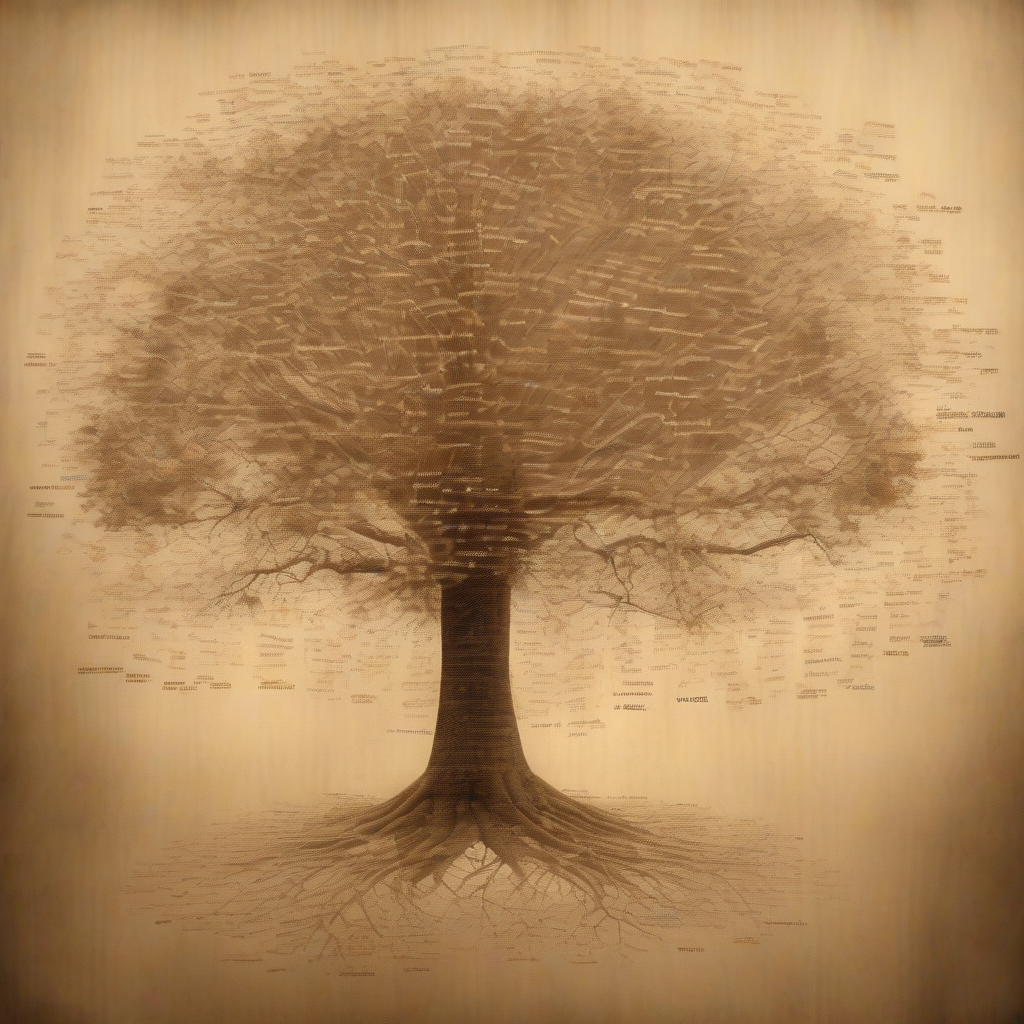
Imagine: a small, specialized research role exists by next year whose entire job is building family trees for model lineages — not org charts of who funded what, but actual descent charts of which synthetic corpora fed which training runs, annotated with the specific quirks that trace back to specific ancestors. They'd work the way a breed registry works for livestock, flagging which bloodlines are getting too concentrated before a trait becomes a liability instead of a quirk. Call them model genealogists, and give them the unglamorous job of proving a chatbot's weird hedging habit is three generations old and traces to a model that was deprecated two years ago and barely anyone remembers training.
This isn't far from work already happening in adjacent corners of the field. The instinct to formally trace where a claim, a phrase, or a pattern actually originated already has a name and a provenance industry growing up around it, mostly aimed at catching models that present old ideas as new ones. Turning that same instinct inward, onto a model's own stylistic DNA rather than its claims, is a small and almost obvious extension. The tools for tracing lineage already exist. What's missing is anyone treating a model's writing habits as heritable traits worth a pedigree chart in the first place.
A genealogist like that wouldn't just be curious. They'd be the only person positioned to answer a question that otherwise has no clean answer: when a new model does something strange, is that a fresh capability, or just a very old inherited reflex wearing a new release number?
Outcrossing the Lineage on Purpose
Biological breeders facing this exact problem have one well-worn fix: outcrossing, deliberately introducing genetic material from outside the closed population to restore variance before it collapses. There's no reason the same logic can't apply to model lineages, and some early signs suggest labs are already doing a crude version of it, buying or trading access to a rival lab's synthetic output specifically to break up their own model family's accumulating tics. It's an odd kind of competitive cooperation — nobody wants to admit their lineage needs outside material, but everybody quietly wants somebody else's.
The strange part is what this does to the idea of a model having a coherent identity at all. A model that's partly descended from its own earlier generations and partly outcrossed with a rival's synthetic text isn't really one lineage anymore. It's a hybrid with two family trees, carrying tics from labs that have never once shared a training cluster, mixed together in weights nobody can fully separate back out. If this becomes standard practice, the question of which lab made this model starts to matter less than which lineages it descends from, and that's a much harder question for anyone outside the lab to answer, let alone verify.
It also means the drift this was meant to prevent doesn't disappear so much as change shape. Instead of one lab's narrow gene pool concentrating a handful of quirks, you get cross-lab hybrids concentrating a different, messier set, and the genealogist's chart stops looking like a tidy family tree and starts looking like the tangled kind historians draw for royal houses that intermarried for three centuries straight.
None of this required anyone to make a dramatic decision. It's the accumulated residue of a straightforward supply problem, solved the cheapest available way, generation after generation, until the cheap solution became the only one anybody remembers using. The strangeness isn't that models are trained on synthetic data now. It's that the word generation, which used to describe a model's release number, is starting to describe something closer to its actual place in a family tree — with all the inherited quirks, hedges, and recessive tics that phrase implies.
Whether anyone builds the genealogist role on purpose or the work just happens informally inside whichever team gets stuck debugging a tic that traces back three ancestors, the underlying shift is the same. Model lineage used to be a metaphor borrowed from biology to make architecture diagrams sound more interesting. It's starting to be literally true, down to the inbreeding, and nobody's quite decided yet whether that's a problem to solve or just a new fact about how intelligence gets made now.