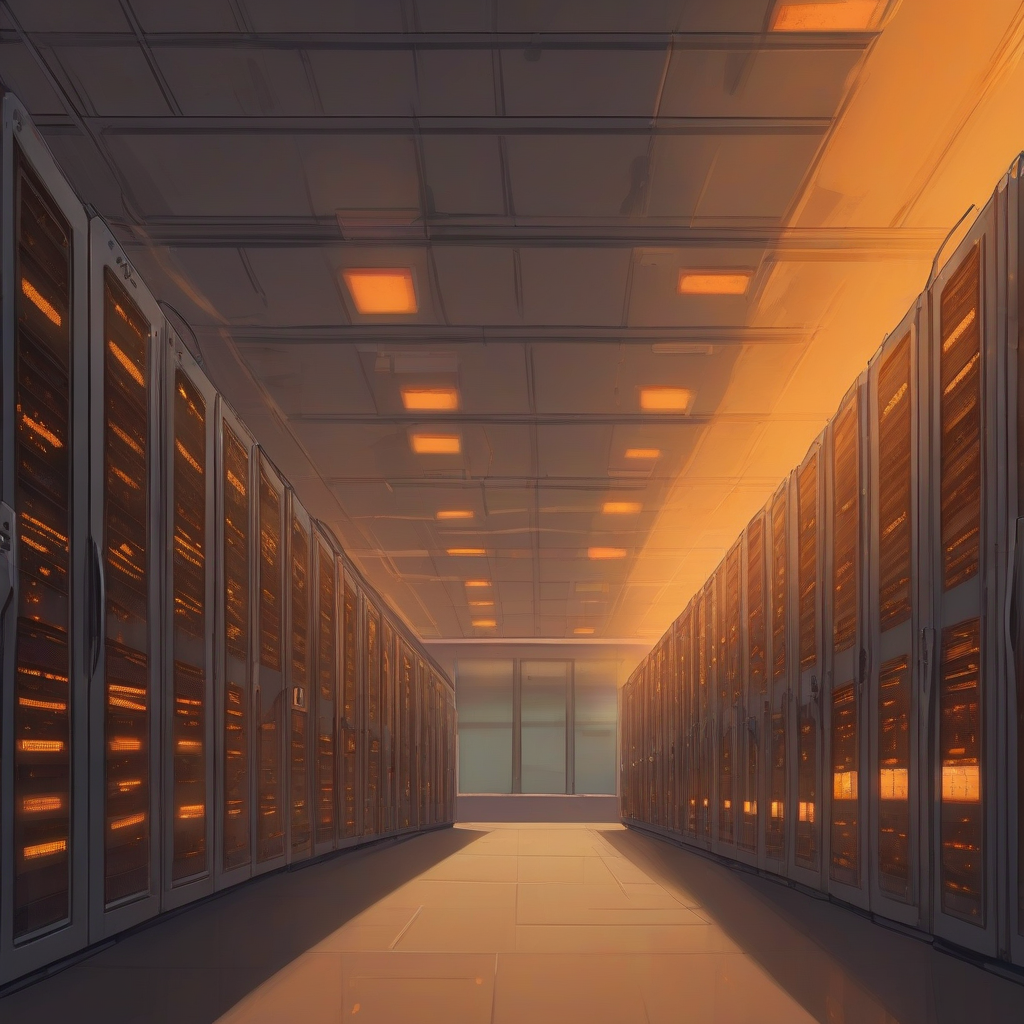
AI Data Center Cooling Is Starting to Look Alive
Somewhere under a data center in Virginia or Iowa or wherever the next campus breaks ground, a rack is running hot enough to need its own weather system. AI data center cooling used to mean a fan and a thermostat. Now it means tens of kilowatts per rack, liquid loops threading between GPUs like plumbing in a body, and pumps that respond to load spikes faster than any technician could turn a dial. Worldwide data center power demand is climbing fast enough that energy, not chips, has become the bottleneck everyone quietly worries about.
That shift changed what cooling has to do. A traditional data hall held a flat, boring temperature. An AI training cluster runs like a fever that spikes with every batch, and the cooling system has to track it in real time or the hardware throttles itself into uselessness. So operators built cooling networks dense with sensors, feeding control loops that adjust flow rates a hundred times a minute. Nobody set out to build something that behaves like an organism. They just needed the racks to survive the workload. But look at what came out the other end, and the resemblance is hard to unsee.

What AI data center cooling actually looks like now
The numbers alone explain the redesign. Optimized AI racks now pull 30 to over 100 kilowatts, against 5 to 15 for the servers these buildings were designed around a decade ago. Air cooling stalls out well before that ceiling, so liquid has taken over: cold plates bolted directly to chips, manifolds distributing coolant hall by hall, and heat exchangers dumping the load outside almost continuously. None of it is exotic by engineering standards. It is closer to a car radiator scaled up by a thousand and wired to a nervous system of temperature sensors.
What makes it strange is the control layer sitting on top. Because AI workloads are so bursty, static cooling schedules waste enormous amounts of energy and water. So facilities increasingly let software tune the flow continuously, trading a fixed setpoint for a system that is always adjusting toward whatever the current load demands. That's a reasonable engineering choice. It is also, mechanically, a feedback loop that behaves less like a machine following instructions and more like a body maintaining homeostasis. For readers who've followed how local AI hardware quietly diverges from its cloud twin, this should sound familiar: give a system enough sensors and enough room to adjust itself, and it stops looking like a tool and starts looking like a creature adapting to its environment.
Imagine: the building keeps its own secrets
Imagine: a technician pulls up the thermal dashboard for a new training cluster and sees a flow pattern the control system settled into on its own, a slow oscillation between two cooling zones that shouldn't be talking to each other at all. Nobody programmed the oscillation. It emerged from thousands of small adjustments, each one locally sensible, compounding into a rhythm that only shows up if you watch the whole building at once. The engineers can reconstruct roughly why it happens. They cannot predict when the pattern will shift into a new one.
Speculative scenario: five years from now, veteran data center operators talk about their facilities the way ranchers talk about land. This building runs hot in the north hall by August and nobody's sure why. That one hums quiet until a training run crosses some invisible threshold, then it starts pulling coolant like it's trying to get ahead of something. None of this gets written into a manual, because it isn't a fault. It's closer to a personality the facility develops from its own operating history, the way a leased robot inherits its last job's reflexes without anyone deciding it should.
The physiology nobody designed on purpose
Biologists have a word for what these systems are approximating: homeostasis, the maintenance of a stable internal state through constant small corrections rather than one big fixed rule. A body doesn't hold 98.6 degrees by locking a thermostat. It sweats, shivers, redirects blood flow, and constantly negotiates with its environment. AI data center cooling is starting to solve the same problem the same way, because the problem itself, a system generating unpredictable, spiking heat that has to be managed continuously, is structurally the same one bodies evolved to solve.
This isn't a metaphor operators are reaching for on purpose. It's what the physics and the economics push them toward. Chasing every kilowatt of waste heat with rigid rules gets expensive and brittle fast, so the systems that survive are the ones flexible enough to absorb surprise, exactly the pressure that shapes biological regulation. The deeper irony is that the compute inside those racks is itself mostly disembodied software, and yet the infrastructure holding it up is developing the most bodily behavior of anything in the building, an echo of how the digital world keeps turning out to have a stubborn physical footprint no one accounted for at the start.
When the building starts making its own calls
The practical risk isn't that a data center becomes sentient. It's simpler and stranger: the cooling logic becomes complex enough that no single engineer can hold the whole model in their head, the same way no single doctor can fully explain a patient's homeostasis from first principles. Facilities already report control behavior that works reliably without being fully explainable, which is fine right up until something goes wrong and the postmortem has to start with 'we're not entirely sure why it did that.'
There's also a competitive angle nobody's fully priced in yet. As neighboring campuses draw from the same power grid and, in some regions, the same water table, their cooling systems will start responding to each other's load indirectly, one facility's heat dump nudging the ambient conditions the next one has to compensate for. Give that a few years and a few more sensors, and you get something like weather forming between buildings that were never designed to talk to each other at all, a slow thermal conversation nobody scheduled and nobody can fully switch off.
None of this required anyone to build something lifelike on purpose. It fell out of a much more boring problem: keep the chips from cooking themselves while the power bill stays survivable. But physiology built by accident is still physiology. The next generation of data centers may end up less like buildings and more like organisms that happen to be made of copper, glycol, and glass, quietly regulating themselves in ways their own operators are only starting to learn to read.